

Laser in Root Canal Treatment — What Does It Actually Mean for the Patient?
Many patients today hear that modern root canal treatment can involve the use of lasers. For some, it sounds very advanced and modern. For others, it may even sound a little intimidating. In reality, the purpose of the laser is quite simple — to help clean and disinfect the root canal system more effectively, especially in areas where traditional instruments cannot always reach.
The root canal system is not just a straight “tube” inside the tooth. It contains tiny branches, narrow spaces, and microscopic irregularities where bacteria can hide. That is why successful root canal treatment depends not only on mechanical instrumentation, but also on how effectively the infection is removed.
Why Is a Laser Used in Root Canal Treatment?
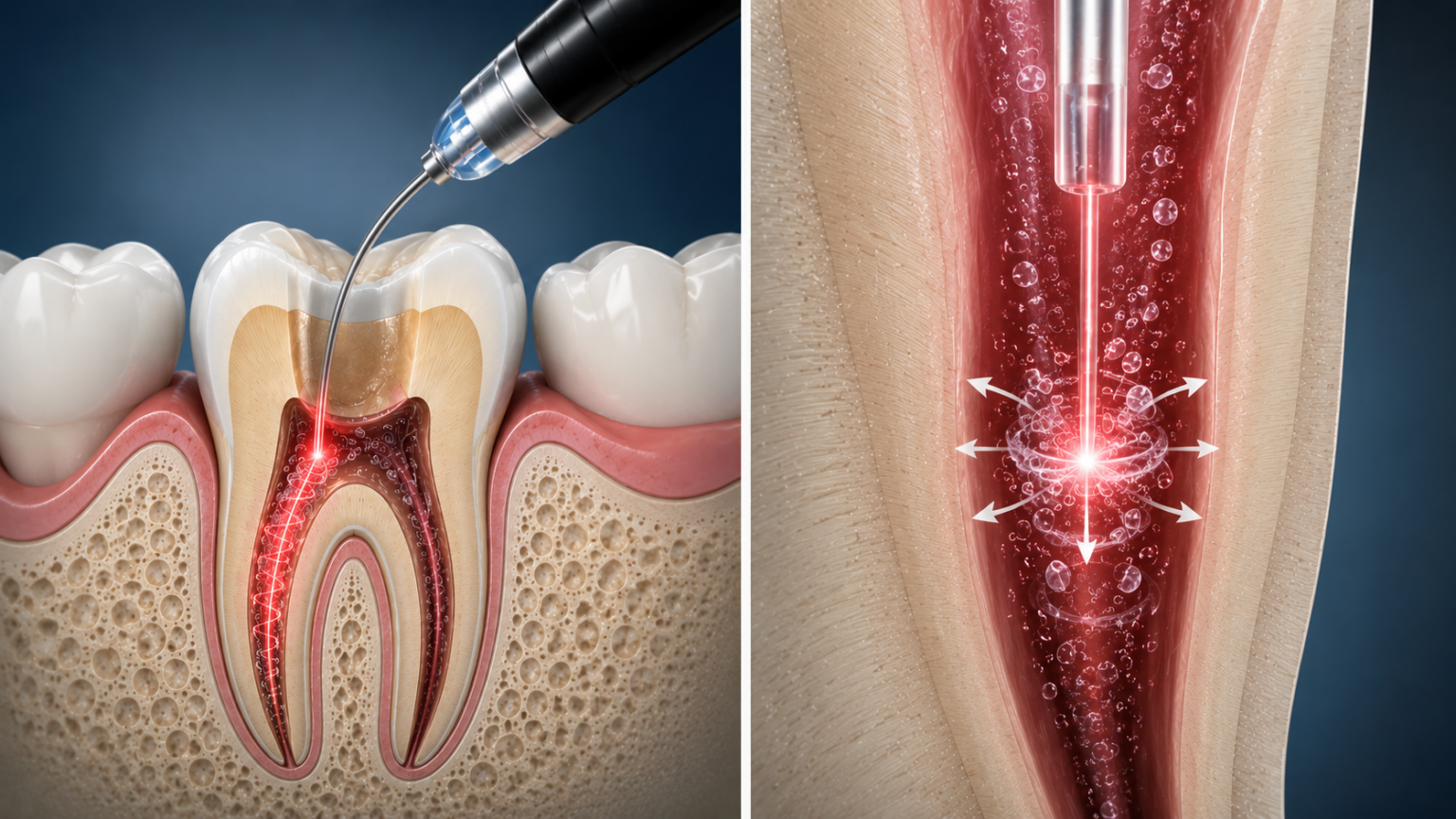
In modern endodontics, lasers are mainly used to activate irrigation solutions — the disinfecting fluids used during treatment.
Simply put, the laser does not “burn out” the inside of the tooth. Instead, it helps the cleaning solution move more effectively throughout the root canal system.
Scientific studies show that laser activation creates rapid fluid movement and microscopic bubble activity, helping disrupt bacterial biofilm and improve cleaning in areas that instruments alone may not fully reach.
Does This Mean Better Treatment?
A laser alone does not automatically make treatment successful. The foundation of high-quality root canal treatment still depends on:
- accurate diagnosis
- careful canal preparation
- effective disinfection
- high-quality root canal filling
- a well-sealed final restoration
However, laser technology can be a valuable addition to modern treatment protocols, especially in teeth with more complex anatomy.
This is why lasers are often used together with an operating microscope. Magnification and enhanced visibility allow treatment to be performed more precisely and more conservatively.
Is Laser Treatment Painful?
This is one of the most common questions patients ask.
In reality, patients usually do not feel the laser itself as a separate sensation or pain. Root canal treatment is performed under local anesthesia, and for most patients the experience is very similar to conventional modern root canal treatment.
In endodontics, the laser is not used to “burn” the canal, but rather to improve cleaning and disinfection.
Why Is Laser Technology Becoming More Common in Modern Endodontics?
The goal of modern endodontics is not simply to enlarge the canals as much as possible, but to preserve as much healthy tooth structure as possible.
If cleaning can be improved through activated irrigation, treatment can often be performed more conservatively while still achieving excellent disinfection. Preserving more natural dentin is important for the long-term strength and prognosis of the tooth.
That is why laser-assisted irrigation is becoming increasingly common in specialized endodontics and microsurgical root canal treatment.
Final Thoughts
Laser technology in endodontics is not a “magic solution,” but when used properly it can be a very valuable part of modern root canal treatment.
For patients, it mainly means a more advanced approach, improved attention to detail, and an effort to achieve the highest possible treatment quality.
Most importantly, successful treatment is never about a single device alone. Experience, proper diagnosis, microscope-assisted treatment, and evidence-based protocols always work best together.