

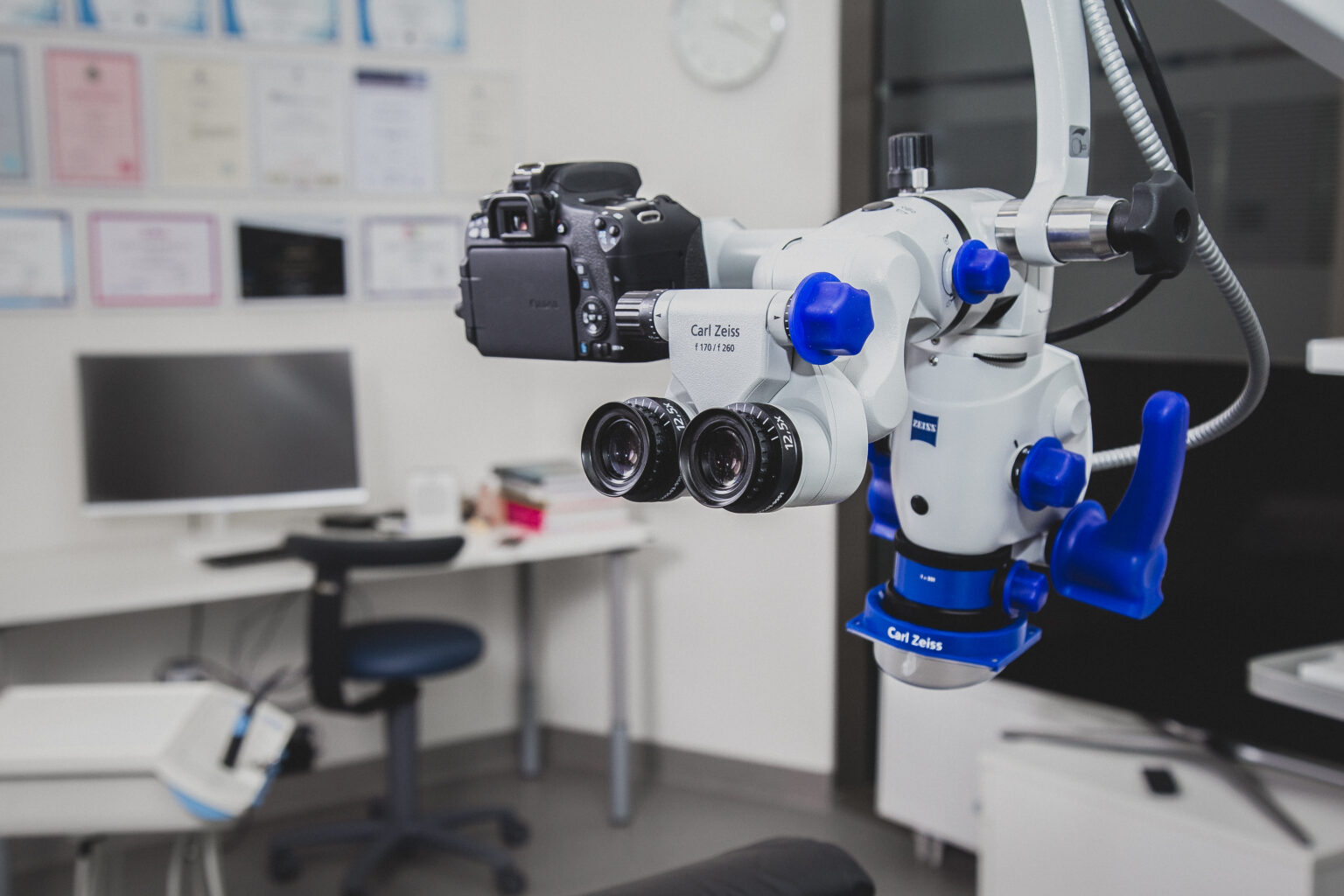
The aim of root canal treatment is to preserve a tooth that would otherwise need to be extracted. In modern dentistry, it is a predictable and effective treatment method, the success of which largely depends on precision. The root canal system is not a straight and simple tube, but a complex microscopic network that contains accessory canals, branches, and anatomical variations that cannot be adequately assessed with the naked eye.
Therefore, today it is impossible to speak of high-quality root canal treatment without magnification. “The use of a microscope is not merely a technological addition, but an essential part of quality treatment. It allows us to work with significantly greater precision and reduces the risk of something being overlooked,” comments Dr Vitali Gavrilin, founder of the Microstyle dental clinic, specialist in root canal treatment, and president of the Estonian Endodontic Society.
The root canal system is more complex than it may appear at first glance
Scientific studies confirm that root canal anatomy is extremely variable. A single tooth may contain more canals than initially expected, and some of them may be very narrow, calcified, or hidden.
Without sufficient magnification, these canals may remain undetected, which is one of the main reasons for root canal treatment failure.
A microscope allows the dentist to work under magnification and coaxial illumination, which significantly improves visibility and makes it possible to detect accessory canals, microcracks, and narrow canals, as well as assist in removing fractured instruments.
Precision reduces risks and improves treatment outcomes
The main reasons for root canal treatment failure are inadequate cleaning and disinfection, the persistence of bacteria in the root canal, and incomplete filling of the canal.
The use of a microscope makes it possible to work much more precisely and in a more controlled manner, helping to remove infection more effectively, preserve more healthy tooth structure, and avoid procedural errors.
“Precision reduces risks and improves treatment outcomes,” emphasizes Dr Gavrilin.
Greater precision also means a lower need for retreatment, which is important in terms of the patient’s health, time, and costs.
The first choice is always to preserve the patient’s own tooth
“In modern dentistry, the primary goal is to preserve the patient’s natural tooth, following the principles of minimally invasive treatment,” explains Dr Gavrilin.
Modern dentistry is based on a minimally invasive approach — the goal is to preserve the patient’s natural tooth for as long as possible. Although implants and other replacement solutions have advanced, they cannot fully replace a natural tooth either biomechanically or in terms of long-term prognosis.
It is often mistakenly believed that root canal treatment is only a temporary solution and that an implant is a better alternative. In reality, high-quality root canal treatment is often the most conservative and the best treatment option for the patient.
Microscopic root canal treatment supports this approach by making it possible to successfully treat even complex cases that in the past would have resulted in tooth extraction.
International standards and clinical practice
The use of an operating microscope is now an internationally recognized standard in specialized endodontics. Scientific literature emphasizes that magnification and adequate illumination significantly improve diagnostics, procedural precision, and treatment success.
Root canal treatment performed without a microscope is not necessarily of poor quality, but it does limit the clinician’s ability to see and assess all important details. This, in turn, may affect the treatment outcome and prognosis.
If you need a specialist’s assessment…
When it comes to root canal treatment, precision is not something to compromise on. If you have questions, doubts, or need a second opinion, it is advisable to consult a specialist.
Dr Vitali Gavrilin, a specialist in root canal treatment, deals on a daily basis with even the most complex cases and helps find the best possible solution for preserving your tooth.
Via this link, you can book a visit at a time that suits you.